
How to Include your Dietetic Internship on Your Resume
Written By: Kelan Sarnoff, MS, RDN

Completing your dietetic internship is a massive accomplishment. You’ve successfully completed over 1,000 hours of supervised practice across clinical, community, foodservice, and business settings. You’ve developed presentations, led in-service trainings, created patient handouts, and counseled real patients.
So now that you’re done, the big question is: how do I include my dietetic internship on my resume in a way that actually gets me interviews?
I get this question constantly from new dietitians, and the answer isn’t as straightforward as you might think. In this post, I’ll walk you through exactly how to showcase your internship on your resume in a way that highlights your skills and lands you that first RD job.
I’ll also share tips on how to include your DI experience on your resume as you progress in your career.
Where should I put my Dietetic Internship on my resume?
First, we’ll cover the most common question I receive: Do I put my dietetic internship under experience or education?
Here’s what I recommend: include your dietetic internship under experience, specifically under a subheading titled either “Professional Experience” or “Nutrition Experience.”
As a new dietitian, you may not have extensive work experience yet, and that’s completely normal. Your dietetic internship is real, hands-on experience that demonstrates your competence as an entry-level RD. Including it under experience adds substance to your resume and showcases the tangible work you completed.
As you gain more professional experience, you’ll likely remove your dietetic internship from the experience section altogether. You can condense it to just the program name and duration under your education section. But if you have little to no other dietetic work experience, your internship belongs front and center under experience.
What information should be included?
Next, we’ll cover what information needs to be included about your internship. At a minimum, include the program’s name, the total number of supervised practice hours completed, and the dates of the program.
From there, prioritize your accomplishments based on the types of jobs you’re applying for. If you’re applying for foodservice positions, move your foodservice rotation to the top and highlight more accomplishments from that rotation. Remember, your resume should be tailored to each job you apply for.
You do not need to include every detail about each rotation site.
The following information may or may not be relevant:
- Rotation site name and type
- Total hours spent at site
- Key accomplishments
Skip the address or city/state for each rotation site (that’s overkill). You also don’t need to list specific dates for each rotation or list them in chronological order.
Depending on how much other work experience you have, you can include more details for some rotation sites and fewer details for others.
Example Resume Showing DI Experience
Here’s how an entry-level dietitian interested in a community position might list their dietetic internship experience:
Dietetic Internship, University of Ohio
August 2023 – May 2024
Community Nutrition Rotation, Garden State WIC (120 hrs)
- Developed and implemented nutrition education curriculum for 200+ WIC participants focusing on infant feeding and childhood obesity prevention
- Partnered with local food bank to create culturally appropriate recipe cards distributed to 500+ families
- Conducted needs assessment survey with 75 community members to identify barriers to healthy eating
Clinical Nutrition Rotation, Forest Grove Hospital (480 hrs)
- Assessed and provided nutrition care for 60+ patients across medical, surgical, and ICU units
- Created patient education materials that improved discharge nutrition knowledge scores by 30%
Foodservice Management Rotation, Forest Grove Hospital (320 hrs)
- Collaborated with kitchen staff to implement food waste reduction program that decreased waste by 15%
- Conducted menu analysis and recommended modifications to meet updated dietary guidelines
This is just one example. You might include more or less information depending on the job description. Make sure you tailor each resume to the specific position you’re applying for.
What Kinds of Responsibilities and Accomplishments Should You Include Under Each Rotation?
During your internship, you likely completed dozens of projects and daily tasks. So how do you know which ones matter most?
Go back to the job description. Let it guide you.
Remember, it’s okay to highlight accomplishments or projects that were smaller tasks. You want to show that you have experience that matches the job requirements.

For example, if the job posting states: “Must have experience with motivational interviewing and patient education,” then highlight the times you used these skills. Maybe you did this in both your clinical and community rotations. You can showcase these accomplishments by focusing on the different ways you provided patient education. Perhaps you did one-on-one counseling and facilitated a group education class. Include both.
For your other rotations, highlight transferable skills. Maybe you created a presentation and taught food sanitation to 100 employees. This would be perfect to highlight for a clinical position that requires public speaking and group education.
You don’t have to include a high level of detail for every rotation you completed. If you don’t have much space on your resume, you can and should omit details that aren’t relevant to the position.
How Can you make your dietetic internship experience stand out on your resume?
Sometimes the dietetic internship feels like a blur and you’re not quite sure what you actually accomplished. But I promise you accomplished impressive work.
Here’s how to make it sound that way on your resume:
Quantify your experience. Numbers make your accomplishments tangible and memorable. Include the number of patients you saw during clinical rotations, the number of meals you helped prepare in foodservice rotations, or the percentage of improvement in patient outcomes you achieved through a project or initiative.
If you need help writing high-impact accomplishments or identifying keywords in job descriptions, I highly recommend booking a one-on-one session with me.
Use strong action verbs. When describing your responsibilities and accomplishments, start each bullet point with a strong action verb to make your experience more impactful.
Here are examples of how to make your bullet points stand out
Instead of: “Assisted with patient education”
Try: “Developed and implemented individualized nutrition education plans for over 50 patients”
Instead of: “Provided nutrition education to patients with diabetes”
Try: “Counseled 60+ patients with diabetes using motivational interviewing techniques across inpatient and outpatient settings”
Instead of: “Participated in weekly nutrition rounds with the care team”
Try: “Presented nutrition assessments and evidence-based recommendations to interdisciplinary team for 15+ patients weekly”
Instead of: “Created patient education materials for various disease states”
Try: “Designed five culturally appropriate patient handouts on diabetes management in English and Spanish”
Instead of: “Helped develop and revise menus for the facility”
Try: “Analyzed and revised 30-day cycle menu to meet updated sodium and fiber guidelines for 200-bed skilled nursing facility”
Instead of: “Conducted cooking classes for community members”
Try: “Facilitated six-week cooking class series teaching basic knife skills and meal planning to 25 community members”
Instead of: “Worked on quality improvement project for malnutrition screening”
Try: “Completed malnutrition screening on 80+ patients and presented findings and recommendations to clinical nutrition team”
Not sure what to include? Here are my tips.
Customize your resume. Tailor your resume for each job you apply for. Highlight the experiences and skills that are most relevant to the position, and adjust your bullet points accordingly.
Remember, you don’t need to include every rotation on your resume. If you’re applying to clinical roles, you can include more bullet points for your clinical rotations and either omit your food service rotation or just include 1-2 bullet points.
If you’re applying to a sports nutrition role, you might showcase your sports nutrition rotation first and then anything else where you did presentations or community programming.
If you’re applying to a nutrition analyst role, you might showcase your regulatory experience or anything related to nutrition or menu analysis.
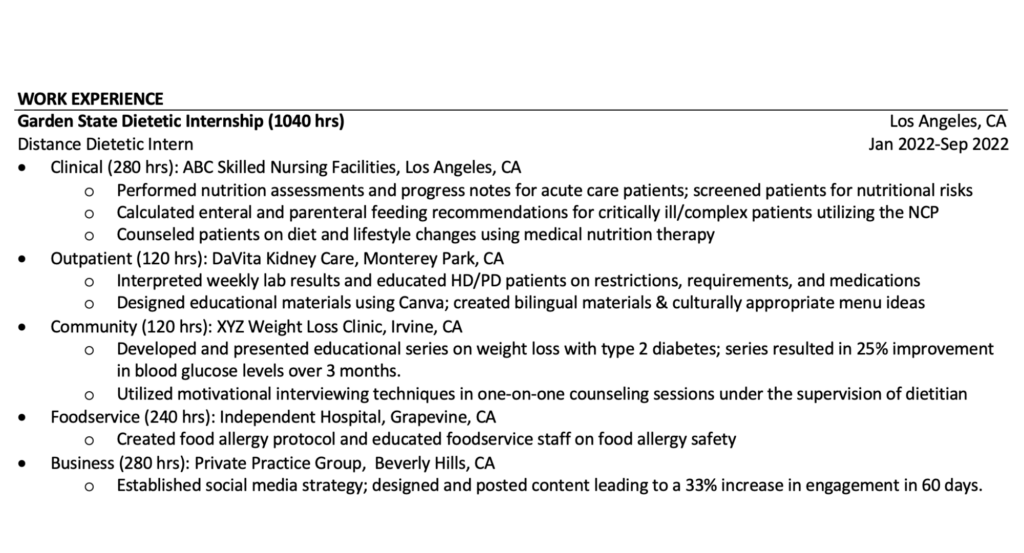
Here is one example of how a recent graduate included their dietetic internship experience on their resume. They did’t have a lot experience and were applying to a clinical role, so they focused on clinical experience.
How do I include my Dietetic Internship on my resume once I have a few years of experience?
Once you have a few years of experience under your belt, you’ll likely find that it’s hard to add your full dietetic internship on your resume. You have a few options:
Include only select rotations that are relevant to the role. For example, you might just highlight food service experience if you’re now trying to pivot to a management role and that was your only experience in food service.
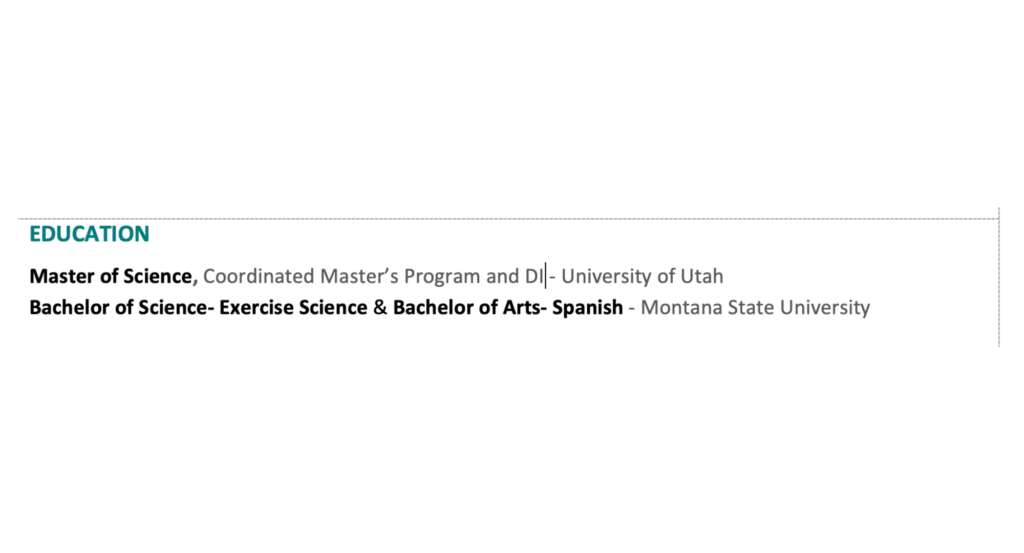
Move your full dietetic internship to your education section and don’t list any details about your internship. Once you have 5+ years of experience, you might not space to highight your rotations and that’s okay. You can just move your internship to your education section and omit rotation specific details. This is how I have it on my resume now that I have 10+ years of experience.
Wrapping up How to Include your dietetic internship on your resume
As you can see, there isn’t one exact one to include your dietetic internship on your resume. You have some flexibility and freedom to include the details that are relevant. The most important thing to consider is “how relevant is this experience” to the roles that I want to apply for.
About The Author
Kelan Sarnoff, MS, RDN is a Registered Dietitian with over 12 years of experience in the nutrition realm. She has experience in hiring and recruitment in both the clinical and academic settings. Kelan is passionate about helping dietitians land a job that aligns with their passion, values, and skills. She also believes in raising the pay for all dietitians and empowering dietitians to negotiate for desired compensation.