3 Common Interview Questions for Dietitians
Written By: Kelan Sarnoff, MS, RDN

If you’re reading this, you’re probably a dietitian who feels nervous about an upcoming interview. I get it. The interview process can feel overwhelming, especially when you’re trying to predict what they’ll ask and how to respond without sounding rehearsed.
Here’s what I know after being on both sides of the interview table: with a few hours of preparation and reflection, you can walk into any interview feeling confident and ready. Today, I’m breaking down three common interview questions that come up in almost every dietitian interview and exactly how to answer them effectively.
Whether you’re a new grad or a seasoned RD looking to make a career transition, these strategies will help you stand out and land the position you want.
The first Few Questions Set the Tone.
Most interviews start with easier introduction questions so the interview team can get to know you. And yes, while ideally everyone in the room has read your resume, that’s not always the case. But here’s the thing: even the “basic” questions are opportunities to showcase your strengths.
Remember, the entire purpose of an interview is for the team to determine if you’re the right fit for the role. This is not the time to downplay your accomplishments or be modest about your experience.
When you practice your responses to these questions, you’ll feel more confident, and that confidence will carry through the entire interview.
Here are the three interview questions for dietitians that show up in nearly every interview in some form or another.
1. Tell me about yourself.
This question catches more people off guard than it should. You might also hear it phrased as “Tell us about your career journey so far” or “Walk us through your resume and background.” They’re all asking the same thing.
Most people skip preparing for this one because it seems straightforward. Big mistake. What I’ve seen happen over and over as a hiring manager is that candidates ramble, share irrelevant personal details, and miss the opportunity to make a strong first impression.
Here’s how to nail it:
Keep it concise. Your answer should be no more than 60-90 seconds. Focus on the most important information that’s relevant to the job you’re applying for.
Highlight your skills and experiences. Start with your educational background, any specialized training, and work experience that directly relates to the position. If your experience is mostly from your dietetic internship, talk about the highlights of your rotations.
Avoid personal details. Give enough context about your background, but don’t share personal information that isn’t relevant to the job. I’ve seen too many candidates focus on hobbies, family details, or personal interests when they should be showcasing their professional qualifications. Plus, mentioning things like having young kids can inadvertently open the door to bias.
Here’s a sample response from an experienced dietitian:
“I’m a registered dietitian who found my calling working with cancer patients and survivors.
My journey started five years ago in outpatient clinical nutrition, where I worked with patients across various disease states. But it was my work with oncology patients that truly resonated with me. I saw firsthand how proper nutrition support could dramatically impact their treatment tolerance and quality of life. That experience drove me to become a Certified Specialist in Oncology Nutrition so I could provide the highest level of care.
In my current role as an oncology dietitian, I’ve moved beyond direct patient care into program development and quality improvement. I spearheaded a facility-wide malnutrition screening and diagnosis initiative that increased our malnutrition identification rate by 40% and improved intervention timing for high-risk patients. Leading cross-functional projects where I coordinate with physicians, nurses, and administration has strengthened my ability to manage competing priorities and drive measurable outcomes.
What excites me most about the Clinical Project Lead position is the opportunity to expand my impact through research. I’ve been following Dr. Thor’s work on nutrition interventions during immunotherapy, and the prospect of collaborating with her team to translate evidence into practice is exactly the type of work I want to be doing at this stage of my career. UC’s commitment to advancing oncology nutrition science aligns perfectly with where I want to grow professionally.”
You absolutely should not memorize your response word for word, but having a framework to answer this question will help you hit your key points while staying on topic. As you’ll see with the next question, the framework is similar for most common interview questions.
2. What inspired you to pursue a career in dietetics and what motivates you to continue in this field?
This question assesses your passion for the profession and your commitment to the position. It seems simple, but it’s actually a bit of a trap.
Employers want to make sure your goals and interests align with the position and their specific area of dietetics. If you’re applying for a clinical position in a hospital and you talk about your passion for school nutrition and healthy school meals, that signals you’re not planning to stick around.
Here’s how to approach this question.

Connect your passion to the position. Before the interview, reflect on your past experiences and what genuinely excites you about dietetics. Then focus on the passion that most closely relates to the role you’re applying for.
Show your long-term commitment. Demonstrate that you’re thinking about growth with the company by explaining how your career goals align with their mission and vision. Show your interest in taking on new challenges within their organization.
Here’s a sample answer:
“As an undergraduate student, I had the opportunity to volunteer in a community kitchen where I taught nutrition and cooking classes to elementary school students. I remember being incredibly nervous for my first lesson, but with a lot of preparation, it was a huge hit.
The students loved it and asked when I would be coming back. I walked away from that experience feeling a passion I had never felt before. I felt alive and energized despite the amount of preparation it took. It was at that moment I realized my passion for working with the K-12 population in a capacity that allows me to provide education and impact access to healthy meals.
I want to be a school nutrition dietitian because I believe in changing the narrative about school meals. I also want to ensure that all kids in our community have access to healthy food options and maybe get a dose of education too.”
The biggest mistake with this question? Inadvertently showing that this job is just a stepping stone to your long-term goal. If you mention you’re passionate about working with pregnant mothers and children and there’s zero opportunity to do that within the company, you’ve just shown you’re not a great fit.
I can’t tell you how many times I interviewed new dietitians for entry-level clinical positions who answered with “I’m interested in gaining clinical experience before I start my own private practice.”
Guess whether we hired them? We didn’t. Turnover is a big deal and it’s costly. While it’s great to gain clinical experience, employers don’t want to hear that your long-term goal is to leave.
I’m not recommending you lie about your interests. Most people have more than one reason for their passion for dietetics and more than one goal. Think about the passions and goals that genuinely align with the position you’re applying for.
3. Why are you interested in this position?
This question is really asking: Have you done your research about the company and the position? Have you thought about how you’ll fit into the organization?
You might also hear this phrased as “Why should we hire you?” or “What makes you stand out among the other candidates?”
Here’s how to answer this common interview question effectively.

Research the company. Before the interview, dig into the company’s mission, values, products or services, and culture. This helps you tailor your response to their specific needs and goals.
Sometimes it might be hard to find specific information on the website- if that’s the case, check out their LinkedIn or even the hiring manager’s LinkedIn.
At one of my first clinical jobs, the mission statement was “helping patients live the healthiest lives possible.” When I was prepping my response to this question, I made sure to weave that mission statement into my reasoning for applying. Companies are impressed when you specifically reference a project, initiative, or mission statement. It shows you’ve done your homework.
When I applied for a role for a dietetic internship program, I wasn’t able to find a lot of information about new program initiatives on the website. So I headed to their Instagram page and found a bunch of highlights to pull into my interview (showing that I did my research).
Highlight your skills and experience. Emphasize the skills and experience that are relevant to the job and explain how they make you a good fit. Use specific examples to demonstrate your qualifications.
Show your enthusiasm. Explain why you’re excited about the job and how it aligns with your career goals. Show genuine interest in the company and explain how you can contribute to their success.
Be authentic. Be honest in your response. Avoid generic answers or flattery that sounds insincere. Provide a genuine and thoughtful response that reflects your actual interest and motivation.
Here’s a sample answer from a new dietitian:
“During my dietetic internship, I had the opportunity to complete my community rotation with the Brookstown WIC Clinic. My preceptor Michelle was a phenomenal teacher and I really enjoyed the camaraderie among the staff. One day we were short-staffed by three dietitians and I was so impressed by how the whole clinic came together to make sure we could see as many clients as possible. It was during this rotation that I realized this is a team environment I want to be part of.
Since completing my rotation with WIC, I’ve furthered my counseling skills and completed additional motivational interviewing training. Because I know that Brookstown WIC primarily serves a Hispanic population, I’ve also started classes in Spanish interpretation so I can better serve future clients.
I’m truly excited about the possibility of working for Brookstown WIC and I can’t wait to launch my career as a dietitian focused on nutrition for women, infants, and children.”
Remember, the interviewer is looking for someone who is passionate, qualified, and a good fit for the company. By demonstrating your knowledge, enthusiasm, and fit, you can show them you’re the best candidate for the job.
A little Preparation Goes a Long Way
It’s impossible to prepare for every question, but preparing for these three interview questions for dietitians will give you a solid foundation. Even this amount of preparation will help you walk into your next interview feeling confident and ready to showcase why you’re the right person for the role.
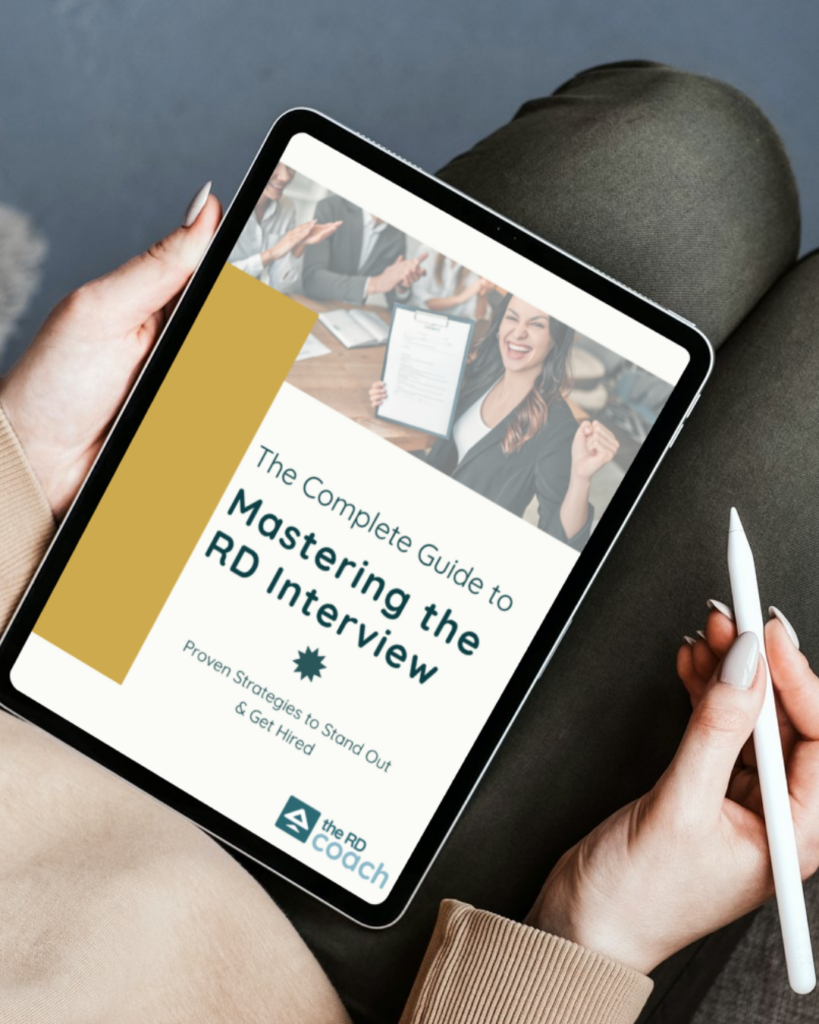
If you’re looking for more sample interview questions for dietitians, check out my Complete Guide to Mastering the RD Interview, which includes over 50 sample interview questions with tips on how to answer them. I also cover the difference between standard interview questions (such as the ones in this post) and situational-based interview questions.
The guide also covers the five types of situational questions to be prepared for and how to create your own story bank.
About The Author
Kelan Sarnoff, MS, RDN is a Registered Dietitian with over 12 years of experience in the nutrition realm. She has experience in hiring and recruitment in both the clinical and academic settings. Kelan is passionate about helping dietitians land a job that aligns with their passion, values, and skills. She also believes in raising the pay for all dietitians and empowering dietitians to negotiate for desired compensation.